
What is Infertility?
For a long time, infertility has been considered a taboo in many a society, but what does it really mean? It’s a clinical fact that around 85% of couples conceive in their first year of trying, after which, an addition 7% will achieve the same results after an additional year. Hence, technically, infertility is defined as the inability to conceive after a year of trying.
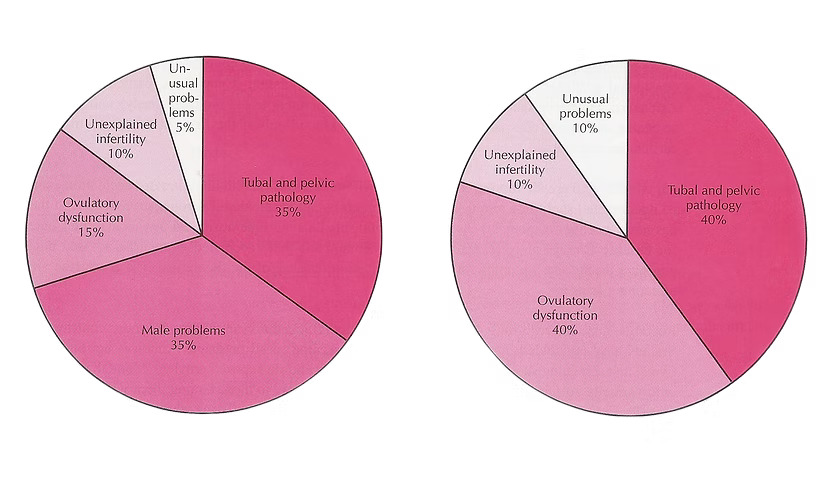
Even though infertility isn’t talked about in common society, around 15% of couples who try are clinically termed as infertile. A common misconception that should be avoided is that infertility is always a woman’s fault, which isn’t the case. Men too, can be infertile. According to a study, about one-third of infertility cases can be attributed to female infertility, while men’s problems actually account for another one-third, and the remaining one-third is a combination of male and female infertility, or might be due to an unknown cause. It is thereby recommended to see a reproductive gynecologist after conception not occurring, after 12 months of actively trying. However, there are exceptions to the previous statements as there are, in fact, certain scenarios where you should consult a reproductive doctor beforehand. Such as if:
If you’re a female of age 35, or older: As a woman grows older, her egg numbers tend to decrease, and to add to which, egg quality also follows the same trend. Therefore, although not impossible, the likeliness of pregnancy is lower than that of a female who is at a younger age.
If you experience irregular menstrual periods: A ‘regular’ period is often one that occurs every 21-35 days, which indicates that a female’s ovulation cycle is regular. Ovulation is the release of the egg from the ovaries, in preparation for fertilization, which makes it integral for pregnancy. Approximately two weeks before the end of the existing cycle, or the start of her next period, a woman is said to ovulate. When a woman has cycles which last longer than 35 days, it results in an unpredictable ovulation, and in some cases, no ovulation at all. Henceforth, when presented with this condition, it is recommended to visit a reproductive consultant to get an evaluation performed, before attempting conception.
Have endometrial polyps, or uterine fibroids: Such uterine abnormalities that damage the endometrial cavity and polyps can affect how the lining of the uterus and fertilized egg, also known as the embryo, interact to lower implantation and pregnancy rates. Such abnormalities can also be the reason behind irregular bleeding between menstrual cycles. It would be advised to seek out a medical evaluation, if these conditions are known. The main treatment for correcting these abnormalities is a surgical method knows as hysteroscopy. Hysteroscopy is a minimally invasive surgery, where a narrow scope with a camera is placed into the uterine cavity. Further instruments can be introduced in order to correct the abnormalities.
Have a history of pelvic infections or sexually transmitted diseases: STIs, or better known as sexually transmitted infections, include the likes of chlamydia or gonorrhea, tend to cause scarring and inflammation in the fallopian tubes. These tubes are essential for natural conception as they provide a pathway for sperm to travel through, in order to fertilize the egg. For any woman that has a history of pelvic infection, an evaluation, known as HSG, would be recommended.
- Known male factor semen abnormalities: If the male partner in point has a history of infertility with a previous partner, or has seen abnormalities on his semen analysis, then, further evaluation may be required.